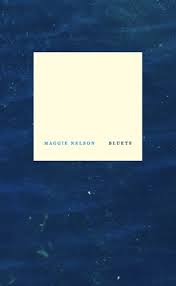
Background: Maggie Nelson (she/her) is an American writer. She was born in California in 1973. She is known for breaking and writing across genres, including memoir, academic essays, fiction, and poetry, to name a few genres she has written in and between during her writing career. Her works include The Argonauts (2015); The Art of Cruelty (2011); Bluets (2009); Women, the New York School, and Other True Abstractions (2007); The Red Parts: Autobiography of a Trial (2007); Something Bright, Then Holes (2007); Jane: A Murder (2005); The Latest Winter (2003); and Shiner (2001), and more. Awards she has won include the National Book Critics Circle Award in Criticism, New York Times Notable Book of the Year, the Susanne M. Glasscock Award for Interdisciplinary Scholarship, among others. She lives in Los Angeles with her partner, Henry Dodge, and their two children while teaching at the School of Critical Studies at California Institute of the Arts.
Categorized by many booksellers as an “essay” or just simply “literature,” I would argue that Bluets (2009) by Maggie Nelson is neither; instead, it is classified by its un-classifiability. It is simultaneously essay, creative non-fiction, prose, poetry, and memoir. The language sings of poetics, it breathes from lived experience, and is knitted together by expertise in writing fiction and essays.
Bluets, from its premise, is a book about an infatuation–an obsession–with the color blue. Nelson declares as such with her opening line: “Suppose I were to begin by saying that I had fallen in love with a color” (1). What is love if not an obsession, thinking of one’s love every waking moment of every day and still struggling to find the words to describe the intangible, to give meaning to the indescribable?
Even when I first read it, I instantly fell in love with Nelson’s unique writing style and numbered list format in Bluets. As an avid list-maker myself, the form resonated with me in a way I don’t know that I’ll be able to properly explain. Perhaps it was the presentation of a chronological, matter-of-fact, non-negotiable list, like a to-do list where tasks can get crossed off, forgotten. A pile of sticky notes ripped up and thrown in the trash. Perhaps it was the opposite nature of the content; rather than emotionally distant, it was intensely personal and intimate in every sense of the word. Nelson explores depression, sex and the grief of heartbreak, loneliness and, of course, the color blue in all of her collected refractions of the shade.
When I first encountered this genius piece of writing, it was in January 2020, while I was still an undergraduate at the University of Virginia and right before the world was plunged into the uncertainty of COVID lockdowns and remote work/school. I had recently gone through and was still grieving a break-up, so it was a fitting time to discover a meditation on the color of solitude, of the night sky, of “a little blue flower” (in French, bluet; 45).
It was also a period in which I was growing as a writer and a poet, learning how to bend and break genre conventions just for the fun of exploration and rebellion. Bluets was an incredible inspiration, with its numerical list of “crots”–little pieces of writing that existed somewhere between a stanza and a paragraph, refusing to be defined and yet being given a name anyway.
There are 240 crots in the collection, all building on each other and interweaving threads of simultaneously told stories: the speaker’s sensual romantic relationship and then breakup with “the Prince of Blue,” her ceaseless collection of blue things sent in from all over the world, her struggle with depression and physical pain, her religious beliefs, her research and reflections on color theory and philosophy and everything in between. She seamlessly threads the stories and experiences together, as in this excerpt (1-2, emphasis original):
2. And so I fell in love with a color–in this case, the color blue–as if falling under a spell, a spell I fought to stay under and get out from under, in turns.
3. Well, and what of it? A voluntary delusion, you might say. That each blue object could be a kind of burning bush, a secret code meant for a single agent, an X on a map too diffuse to ever be unfolded in entirety but that contains the knowable universe. How could all the shreds of blue garbage bags stuck in brambles, or bright blue tarps flapping over every shanty and fish stand in the world, be, in essence, fingerprints of God? I will try to explain this
4. I admit I may have been lonely
The nature of the crots allows Nelson to continue the same flow naturally and break off into tangents all at the same time, an incredibly flexible structure she takes full advantage of throughout the piece. She jumps in time, topic, emotion, and space easily with just a line break or lack of punctuation. Nelson integrates personal reflection, conversations with herself, academic research and theoretical philosophy, all in her own linguistic style that is candid and coarse, sometimes callous. For example, she quotes Joseph Joubert, “‘Truth. To surround it with figures and colors, so that it can be seen”’ and immediately undercuts it with her attribution, “wrote Joubert, calmly professing a heresy” (48).
As the reader follows along the path Nelson has set out, it becomes obvious that both reader and writer are making novel discoveries as the piece progresses. Personally, I admired how successfully Nelson accomplished this simply by separating thoughts into different crots and not feeling compelled to connect them. Rather, she let the connections surface naturally and subtly, bringing back dropped threads or images from earlier in the collection to bring themes full-circle towards the end of the book.
When I reread Bluets in 2022, numbers 1 to 240 on Nelson’s blue list, night sky cover to ocean wave cover, I was… detached, mostly. I no longer clung to my obsession with the numbered form. In fact, I read over it. As if it was one linear story and not bits and pieces of stashed away broken glass fractured one too many times or, worse, kept in pristine, polished condition. Reading Bluets again made me think of my own creative non-fiction piece, “Magenta,” which I wrote in 2020. It mimicked Nelson’s form but told the story of my own color, my own heartbreak. It was something I needed to write.
What remained consistent about my interpretation of Bluets was an admiration for its unrestrained jumping, the parallel play that does not need to see its reflection in the mirror because it knows the other (the speaker, the reader, etc) is there, following along. I admire the way Nelson weaves various threads of cohesive thoughts—the story of her relationship with the Prince of Blue, her ponderings on her collection of blue trinkets and her blue correspondents, literal philosophy and quotes from scholars or famous writers, historical or epistemological renderings of blue and its idioms. Alone, these stories are interesting. Combined, the way she sews them and breaks them apart with her own experiences and revelations, they are fascinating.
I must acknowledge, also, that I was not quite as enraptured as I was the first time I encountered her work. I found myself frustrated with her gaudy and sophisticated language, her constant references to philosophy and rhetoric. The collection gave me, quite literally, a massive headache.
What I found myself admiring instead, this time around, was more nuanced: the slight sass in her tone when she called out Joubert for “calmly professing a heresy” (48). I appreciated the subtly of her staging and framing: clearly setting up the reader to have one expectation and flipping them at the last moment, such as in crot 76, which discusses depression and mental health before taking a strong turn into social commentary:
“We don’t store our oils in the bladders of pigs anymore. We go to the store. If we want to know what a phosphene is, we […] Google it. If you’re depressed, you take a pill. Some of these pills are bright blue. If you’re lonely, there’s a guy on craigslist two blocks away who says he has an hour to kill and a dick longer than a donkeys. He has posted a photograph to prove it” (Nelson 29-30).
Nelson sets up a pattern of explaining unreasonable and illogical things that humans have done in the past and then replacing them with modern, more “logical” responses to the same problems. In doing so, also sets up the expectation that the second option, the modern one, will be “better” and then usurps this with the last example in this stanza, which emphasizes how disconnected human connection has become from physical sex. What the speaker craves in that moment of loneliness is not the physical pleasure of sex, but the emotional connection of intimacy and being known, seen, loved.
Ultimately, that becomes a major theme in Bluets: loving and being loved, and all of its messiness. Nelson is unafraid to dive into intimate details and unfiltered convictions, quoting established scholars and then challenging them. I highly recommend Maggie Nelson’s Bluets for anyone who loves cross-genre writing, for anyone longing for their own Prince of Blue, for anyone who wants to be surprised at every turn from “loneliness is solitude with a problem” to “we fucked for six hours straight” and all the Buddhist axioms in between (28, 46). One thing is for certain: you will not look at anything blue the same way again.
Works Cited:
“Maggie Nelson.” Poetry Foundation, Poetry Foundation, https://www.poetryfoundation.org/poets/maggie-nelson.
“Maggie Nelson.” Wikipedia, Wikimedia Foundation, 13 Jan. 2022, https://en.wikipedia.org/wiki/Maggie_Nelson.
Nelson, Maggie. Bluets. Wave Press, 2009.
 Kasey Roper